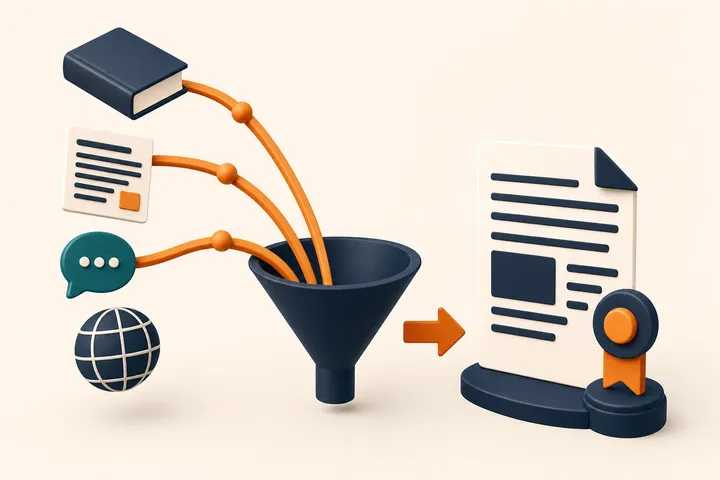
To write content that LLMs cite, put a direct answer in the first sentence of each section. Back it with specific facts, ideally your own data. Name your brand, product and topic the same way every time. Format comparisons and steps as tables and lists that a model can lift cleanly. Clear, self-contained sentences are easier for ChatGPT, Perplexity and Google AI Overviews to quote than long build-ups.
Most SaaS articles bury the answer under background, vary the product name from page to page, and describe features in long prose blocks. Each of those habits makes a page harder to extract and quote.
The good news: the fixes are editorial, and you can apply them to articles you already have. No one can guarantee a citation, but you can remove the reasons a model would skip your page.
Short answer: the citable content formula
A citable page answers a question quickly, states facts a model can verify, and uses structure a model can pull apart without losing meaning. Here is how to write content that LLMs cite, as a checklist you can run on any article.
- Answer first: the first sentence under each heading answers the heading's question.
- Specific facts: numbers, dates and named sources instead of "many" or "most."
- Original data: something only your company can publish, such as product usage patterns or survey results.
- Consistent entities: one name for your brand, one name per product, one definition per term.
- Extractable structure: tables for comparisons, numbered lists for steps, bullets for parallel items.
- Self-contained sentences: each key claim makes sense if quoted alone.
Eligibility comes first. Google says a page needs to be indexed and eligible to show a snippet in Search to appear as a supporting link in AI Overviews. Google does not list a required ranking position. Its AI content guidelines also focus on helpful, people-first content, whatever tool wrote it. For how engines choose sources, see what GEO is, LLM optimization and AI Overviews SEO.
Crawl access matters for other assistants too. If a bot cannot reach a page, the content on it cannot be used. An llms.txt file generator can help you list your most important pages in one place. Treat it as a helpful signal, since support for llms.txt varies by provider.
Answer-first paragraphs
An answer-first paragraph opens with the conclusion, then adds the reason or detail. Answer engines look for passages that match the question, so a passage that states the answer up front is easier to match and quote than one that starts with history. Treat this as an editing rule, not a measured ranking factor.
How to write one
- Turn the heading into a question: "Pricing models" becomes "Which pricing model fits a seed-stage SaaS?"
- Answer it in one sentence: state the recommendation or fact plainly, with the subject named.
- Add one or two supporting sentences: the condition, the reason or the number.
- Move background lower: context and caveats come after the answer, not before it.
Common mistakes
- Warm-up openers: "Pricing is one of the hardest decisions a founder makes" says nothing a model can quote.
- Dangling references: "This approach works best" fails when quoted alone. Name the approach.
- Hedged answers: "It depends" is fine only if the next words say what it depends on.
Keep paragraphs short. One to three sentences per paragraph gives a model clean passage boundaries. Long blocks mix several claims, and the quotable one gets diluted by the rest.
Apply the same rule to your opening paragraph. Treat it as the answer to the page title. A quoted passage can be taken without the text around it, so the first paragraph has to work on its own.
Original data and quotable stats
Original data gives a model a reason to cite you instead of a page that repeats the same general advice. If your page is the only source for a figure, an answer that uses the figure has a clear source to point to. The GEO research paper reports that content changes can raise visibility in generative engine responses by up to 40% in its benchmark; treat that as a research result, not a promise for your site.
Where SaaS companies find original data
- Product usage: aggregated, anonymized patterns, such as the share of accounts that use a feature in their first week.
- Customer surveys: a short survey of your users on one question, reported with the sample size.
- Support tickets: the most common questions in a quarter, grouped by topic.
- Public datasets you analyze: your own analysis of a public source, with the source linked.
How to write a stat that gets quoted
A quotable stat names the number, the population, the source and the time period in one sentence. Compare "Most users adopt reporting quickly" with "In a survey of 412 of our users in March, 61% said they set up a report in week one." The second version stands alone. (Both numbers here are placeholders to show the format.)
- Name the method: sample size, date range and how the data was collected.
- Put the number in the sentence: do not leave it only in a chart image.
- Use one figure per sentence: stacked numbers are harder to quote accurately.
Be honest about limits. A small sample is still useful if you say it is small. Overstated data hurts trust with readers and gives a model a weaker source.
If you have no data yet, write the section as a method the reader can follow. A clear process is also citable.
Entity clarity and consistent naming
Entity clarity means a model can tell exactly who and what your page is about. When your brand appears as "Acme," "AcmeHQ" and "the Acme app" across pages, a model has to guess whether these are one thing. Consistent naming removes the guess.
What to standardize
- Brand name: pick one spelling and capitalization, and use it in titles, body text and schema.
- Product names: one name per product or feature, used the same way in docs, blog and pricing pages.
- Category: state what you are in plain words, such as "invoicing software for freelancers," and repeat it.
- Key terms: define a term once, then use that exact term. Do not swap "workspace" for "project" halfway through.
Write the "who, what, for whom" sentence
Every important page should contain one sentence that names your brand, says what it does and says who it serves. That sentence is what a model needs to recommend you for a matching question. Put it near the top of your homepage, product pages and comparison pages.
Consistency also applies off your site. Your name and category should match on review sites, directories and social profiles. Mismatches give a model conflicting signals about what you are.
Repeat the subject instead of leaning on pronouns. "TalkGenAI drafts articles for your review" survives quoting. "It drafts them" does not. Our guide on using Claude for SEO shows how to run a naming audit with an assistant across your pages.
Structuring tables and lists for extraction
Tables and lists help models extract content because each cell or item carries one fact with a clear label. A model can lift a row or a step into an answer without rewriting it.
When to use each format
| Content type | Best format | Why it extracts well |
|---|---|---|
| Comparing 3+ options on 2+ attributes | HTML table | Each row and column has a label the model can read |
| A process in order | Numbered list | Order is explicit, so steps are quoted in sequence |
| Parallel features or tips | Bulleted list with labels | Each item stands alone with its own name |
| A definition or single answer | Short paragraph | One self-contained sentence is easiest to quote |
Rules for clean tables and lists
- Use real HTML: a table built in HTML is readable text. A screenshot of a table is not.
- Label everything: clear column headers and a bold label at the start of each bullet.
- Keep cells short: one fact per cell, with units included.
- Introduce the list: a lead sentence that says what the list contains gives the model context.
Do not force structure where prose reads better. A table with two items and one attribute is just a sentence in a box. An AI content optimization platform can flag sections that would extract better as lists or tables.
Before/after rewrite example
A rewrite shows how the formula changes a real paragraph. The example below uses a fictional invoicing product, "Ledgerly," to show the pattern.
Before
"Getting paid on time has always been a challenge for freelancers. With so many tools out there, it can be hard to know where to start. That's where our platform comes in. It offers a range of features that can really help, and users love how easy it is."
After
"Ledgerly is invoicing software for freelancers that sends automatic payment reminders. You set a reminder schedule once, for example 3 days before and 7 days after the due date. Ledgerly then sends each reminder by email with a payment link."
What changed
- Answer first: the first sentence says what the product is and does.
- Entity named: "Ledgerly" replaces "our platform" and "it."
- Specifics added: a concrete reminder schedule replaces "a range of features."
- Unverifiable claim removed: "users love how easy it is" had no source, so it is gone.
Run this rewrite on your top five pages first: homepage, main product page, pricing page and your two most visited articles. The Claude for marketing guide includes prompts for this kind of paragraph-level edit.
Frequently Asked Questions
Can I get ChatGPT to cite my website?
You can make your site easier to cite, but no one can guarantee a citation.
- Make sure the page is crawlable and not blocked in robots.txt.
- Open each section with a direct answer to a real customer question.
- Publish original data that other pages do not have.
- Track which questions name you with an AI SEO agent.
Does my page need to rank on Google to show in AI Overviews?
No, Google says a page needs to be indexed and eligible for a snippet, and it does not list a required ranking position.
- Check indexing in Search Console.
- Avoid nosnippet tags on pages you want quoted.
- Write helpful, people-first content.
- Read Google's position on AI-written content rules.
How long should an article be to get cited?
Length matters less than whether each section answers one question clearly.
- Cover the full question your reader has, then stop.
- Keep paragraphs to 1-3 sentences.
- Split long topics into separate articles with one focus each.
- Browse examples in our SEO and AI guides.
Does llms.txt help my content get cited?
It can help some tools find your key pages, but support varies by AI provider.
- List your most useful pages with short descriptions.
- Keep it updated when you publish new pillar content.
- Treat it as a supplement to good content, not a replacement.
- Create one with a free llms.txt tool.
Can I automate writing citable content?
Yes, you can automate drafting, but a person should review each article before it goes live.
- Give the tool your brand voice and naming rules.
- Check every fact and number before approving.
- Add your own data, which a tool cannot invent honestly.
- Compare options in our guide to SEO automation agents.
What is the fastest fix for existing articles?
Rewrite the first sentence under each heading so it answers the heading directly.
- Replace pronouns like "it" with your product name.
- Convert comparisons in prose into HTML tables.
- Delete claims you cannot source.
Start with your top pages
Content that LLMs cite answers first, uses specific facts, names things consistently and puts comparisons in clean tables and lists. Rewrite your five most important pages with that checklist before writing anything new. Start with the first sentence under each heading: if it does not answer the heading, rewrite it. To check whether the changes help, follow the benchmark steps in our guide to AI search optimization.
Sources checked November 24, 2026: Google, AI features and your website; GEO: Generative Engine Optimization (arXiv 2311.09735).