Last updated: 2026-11-18
What does this llms.txt tool do?
It does two jobs. The generator reads your sitemap and drafts an llms.txt: a title, a one-line summary, and your pages grouped into sections. The checker reads any llms.txt, yours or a pasted one, and flags format problems. Both run in your browser. We fetch only one file from your domain, and only to get around the browser's cross-site limits.
Should I make an llms.txt at all?
Honest answer: it costs little and the evidence that it helps is thin.
| Finding | Source |
|---|---|
| 97% of llms.txt files received no requests in a study of 137,210 domains (May 2026). 28% of those domains published one, which Ahrefs says is an upper bound because its customers skew technical | Ahrefs |
| 9.3% of the top 1,000 domains and 8.3% of the top 10,000 serve a confirmed llms.txt (September 2026) | Rankability |
These studies use different samples, so do not compare the percentages directly. The point they agree on: some sites have the file, and the crawlers that were measured mostly did not ask for it. We found no confirmation that ChatGPT, Claude or Gemini fetch it routinely.
So the order of work is: first make sure AI crawlers can read your pages at all (our robots.txt checker tests that), then publish real articles worth citing, then add an llms.txt if you want the extra signal. It is a short file and it does no harm.
How does the generator build the draft?
- It reads
/sitemap.xmlfrom your domain once. If that file is an index of other sitemaps, it reads one child sitemap. - It keeps only pages on your own site and drops things no one needs in a summary: tag and author archives, pages of results, cart, login and account pages, images and feeds.
- It groups what is left into sections by the first part of each address: Key pages, Products, Guides and articles, Docs and help, and Optional for the rest.
- It writes each link as
- [Title](https://your-url). Titles are made from the address, for example/blog/how-to-rankbecomes "How to rank".
The draft is a starting point. Read it, fix the titles, and add a short note after a link where the title is not enough. A good file is short and chosen, not a copy of your sitemap.
What does the checker look for?
| Check | Why it matters |
|---|---|
One # Title as the first line |
It is how the file names your site |
A > summary under the title |
The first thing a reader takes in |
## Sections with link lists |
Gives the file structure |
Links written as [Title](https://...) |
The title travels with the link |
| Full https URLs, not relative ones | The file is read away from your site, so relative links lose their base |
| No duplicate links, no bare URLs | Keeps it clean and short |
| No HTML | A web page served in place of the file is the most common failure |
| Size | Long files cost the reader context |
If your domain answers /llms.txt with an HTML page (common on site builders that serve every address from one app), the checker says so, because for a crawler the file is effectively missing.
What should a good llms.txt look like?
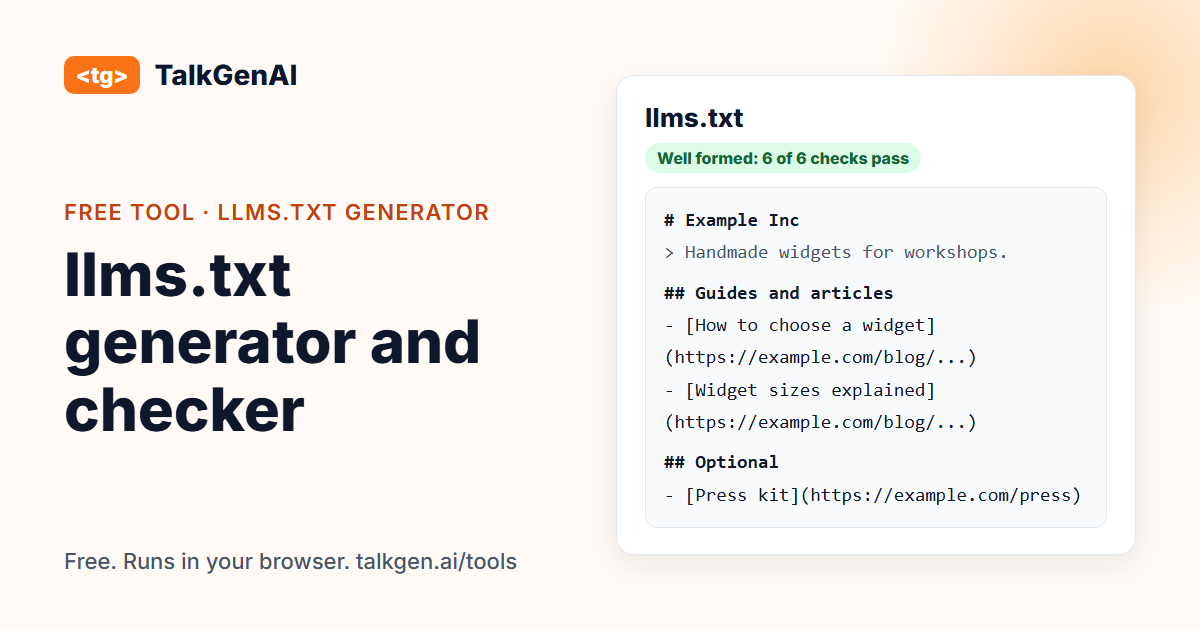
# Example Inc

> Example Inc sells handmade widgets to small workshops in Europe.

## Key pages

- [Pricing](https://example.com/pricing): plans and what each includes
- [About](https://example.com/about)

## Guides and articles

- [How to choose a widget](https://example.com/blog/how-to-choose-a-widget): sizes, materials and common mistakes

## Optional

- [Press kit](https://example.com/press)
What comes after the file?
An llms.txt only points at pages. The pages themselves decide whether an assistant has something worth citing. TalkGenAI writes those articles in your brand voice and saves them to your blog as drafts. You can try it free.
Frequently asked questions
What is llms.txt?
llms.txt is a plain Markdown file at the root of a website, proposed in 2024, that lists a site's most useful pages for AI systems. It has a title, a short summary and sections of links, so a model can find the good pages without reading the whole site. The format is described at llmstxt.org.
Does ChatGPT or Claude read llms.txt?
We found no confirmation that the major assistants fetch it. In an Ahrefs study of 137,210 domains, 97% of llms.txt files received no requests from AI crawlers during the study period. Adding one is cheap, but do not expect it to change whether you are cited.
What is the difference between llms.txt, robots.txt and a sitemap?
robots.txt tells crawlers where they may go. A sitemap lists every page for search engines. llms.txt is a short, curated, human-written list of the pages you most want an AI to read. None replaces the others, and robots.txt access has to be open for any of them to matter.
Where do I put the llms.txt file?
At the root of your domain, so it loads at yourdomain.com/llms.txt, served as plain text. On WordPress that usually means uploading it to the site root or using a plugin. If your site answers every address with an HTML page, a crawler will get that page instead of the file, and the checker will tell you so.
Does the file have to be Markdown?
Yes. The format is Markdown: one H1 with the site name, an optional blockquote summary, then H2 sections with lists of links written as - [Title](https://url). Notes after a colon are optional. A section called Optional marks pages a reader can skip when short on space.
How many links should it have?
A curated list, not a dump. Dozens, not thousands. The generator caps each section for that reason. Put your best explanations, product pages and documentation first, and move the rest to the Optional section.
Does llms.txt help Google rankings?
We have no evidence that it does. It is a separate file that search engines are not documented to use for ranking. If your goal is Google traffic, your pages and your sitemap matter far more.
Do you store my sitemap or my file?
No. We fetch the one file once, keep it in memory for up to an hour so repeat checks are fast, and do not log which domains are checked. Generating, editing and checking all happen in your browser, and a pasted file is never sent anywhere.